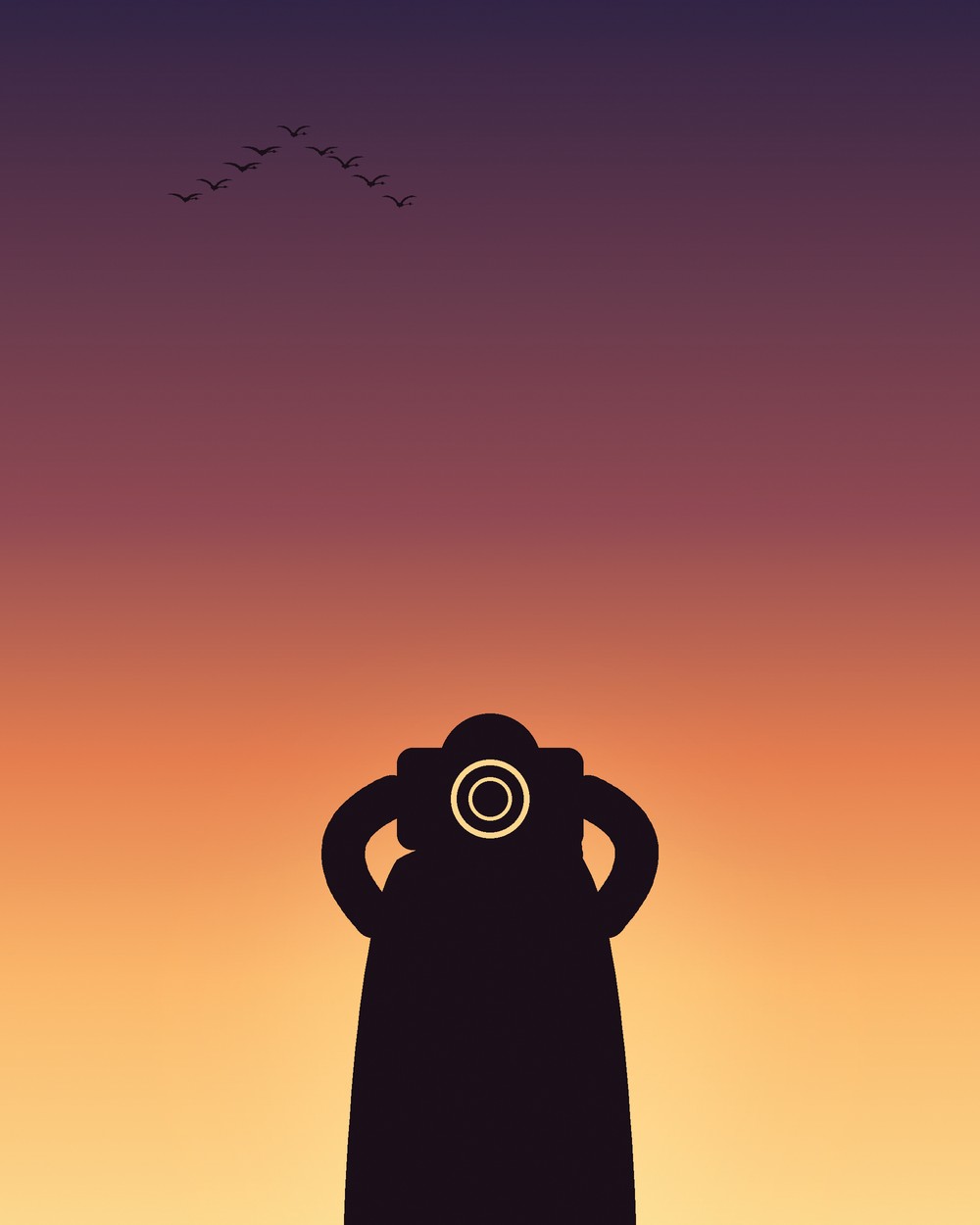
The photographer
About June
Who writes this journal, how it is made, and why it is named after a bird.
I am June “Goose” Aldaco, a travel photographer who has lived in Albuquerque, New Mexico, for most of two decades. The high desert taught me the two things every photograph needs: light worth waiting for, and the patience to wait for it.
The nickname came honestly. Every winter, an hour south of my house, tens of thousands of snow geese settle onto the ponds along the Rio Grande. Five years ago I started driving down in the dark to photograph the morning blast-off, and I have not missed a season since. Friends started calling me Goose. When I finally built a home for my essays, the name was already waiting.
My working life is spent traveling with a small camera bag, through the high desert, big cities, and other people's coastlines, and this journal is the notebook I wish someone had handed me twenty years ago. It is about method: how to shoot through a triple-pane cabin window, which side of the aircraft the light will be on, and what to do with the fifteen quiet minutes after a balloon field empties out.
How I came to it
I did not set out to be a travel photographer. I set out to travel, and the camera came along the way a notebook comes along, as a way of paying attention. Somewhere in the first few years the order reversed: the trips began to organize themselves around light I wanted to be standing in. A dawn I had read about. A window seat on the side of the aircraft where the mountains would be. A city I timed my arrival into so I would land at dusk instead of noon. That reversal, from photographing where I happened to be to going where the photographs were, is the whole story of how an amateur becomes something else.
The high desert made me patient, because it has to. Weather here is theatrical and brief; the good light arrives on its own schedule and leaves without warning. You learn to scout, to wait, and to accept that most mornings you drive home with nothing. The geese taught me the same lesson in a harder classroom. You cannot rush ten thousand birds, and you cannot fake having been there. Either you were sitting in the cold, in the right place, when they lifted, or you were not. Photography that depends on being present cannot be shortcut, and I have come to think that is its great mercy.
What this journal is, and who runs it
Traveling Goose Photography is an independent publication, owned and operated by Traveling Goose Photography LLC, a registered New Mexico Limited Liability Company (LLC) (New Mexico Secretary of State Reg. No. 6248317, formed March 6, 2019). The company's registered office and studio are at 2921 Central Ave NE, Suite 108, Albuquerque, NM 87106, which in practice means me and a desk on Central Avenue. The journal teaches craft. It does not sell photo tours, workshops, presets, gear, or travel services of any kind, and it has no relationship with any airline, airport, booking platform, or equipment manufacturer, which is exactly why no such company is ever named in these pages. Full registration and contact details are on the company page.
How the journal is made
An essay usually begins in a notebook, in the field, as a few lines about something that worked or embarrassingly did not. Back at the desk it becomes a draft, then a slower rewrite in which I check every claim I can check. Where a piece states a fact that a reader might act on, a security rule, a battery limit, a refuge's hours, an astronomical time, I verify it against an official or public source and list that source at the foot of the essay, in plain text, so you can find the current version yourself. The illustration comes last, drawn to match what the writing describes.
Software has a place in that process, the way a light table or a spell-checker always did. I use ordinary editing tools, and I use modern assisted-writing and illustration tools while drafting and producing the plates. Every published page is then read, fact-checked against its listed sources, and approved by a human, who is me, and who is responsible for all of it. If a page is wrong, that is on me, and I would rather fix it than defend it.
What I photograph, and what I do not
The work divides roughly into two halves, which are also the two halves of this journal. Aloft is everything made in motion: the view from a cabin window at altitude, the geometry of coastlines from three miles up, the strange flat light above a cloud deck. Afield is everything made with both feet on the ground: a city on the night I land in it, an airport at four in the morning, a desert an hour before dawn, a river full of birds. What ties them together is that they are all made while traveling, with a small bag, in conditions I do not control and cannot repeat. I am not a studio photographer, and I am not a staged-scene photographer. I take what the day gives and try to be ready for it, which is a discipline more than a talent, and it is the discipline the essays are really about.
A note on gear, since everyone asks
The essays describe equipment generically, as a small mirrorless body, or a slow telephoto zoom, on purpose. Brand talk starts arguments and dates badly; light and technique do neither. Everything I teach works on whatever camera you already own, including the one in your pocket. If a method only works with a particular expensive object, it is not a method, it is an advertisement, and this journal does not run those inside its essays.
Where the pictures on this site come from
The plates that head each essay are original illustrations drawn for this journal. My commissioned photography is licensed separately and mostly lives in print; the illustrations keep this site fast, uniform, and unmistakably ours. Every image here was made for these pages and belongs to them, and none of them depicts a real, identifiable company, aircraft, product, or person.
What you can hold me to
Three promises hold this whole thing up. The writing is original, not scraped, spun, or syndicated from anywhere else. The advice is honest, which sometimes means telling you that a technique is hard or that a morning is likely to fail. And the journal is independent, which means no free travel, no review units, and no paid coverage, so that when I say something is worth doing, the only thing buying the recommendation is the result.
If you want to talk about an essay, correct me, or ask a question about method, the contact page reaches my actual desk, and a person answers, usually within two business days and sooner if the light is bad. Studio hours are Monday to Friday, 9:00 am to 5:00 pm, Mountain Time.